
지금21세기 IT업계가 주목 받고 있는 시대에 그 경쟁 또한 상상할만하죠, 당연히 it업계 중SAP P_SAPEA_2023인증시험도 아주 인기가 많은 시험입니다. 응시자는 매일매일 많아지고 있으며, 패스하는 분들은 관련it업계에서 많은 지식과 내공을 지닌 분들뿐입니다.
| 주제 | 소개 |
|---|---|
| 주제 1 |
|
| 주제 2 |
|
| 주제 3 |
|
| 주제 4 |
|
SAP P_SAPEA_2023시험은 ITDumpsKR 에서 출시한SAP P_SAPEA_2023덤프로 도전하시면 됩니다. SAP P_SAPEA_2023 덤프를 페펙트하게 공부하시면 시험을 한번에 패스할수 있습니다. 구매후 일년무료 업데이트 서비스를 제공해드리기에SAP P_SAPEA_2023시험문제가 변경되어도 업데이트된 덤프를 받으면 가장 최신시험에 대비할수 있습니다.
질문 # 35
As the Chief Enterprise Architect of Wanderlust GmbH, you are aware that EA principles should correlate to the Business and IT Strategic Objectives and decisions. In the list given below, the left column has some Wanderlust Business/IT objectives and decisions and the right column has some EA principles. Which objectives and decisions correlate best to which principle?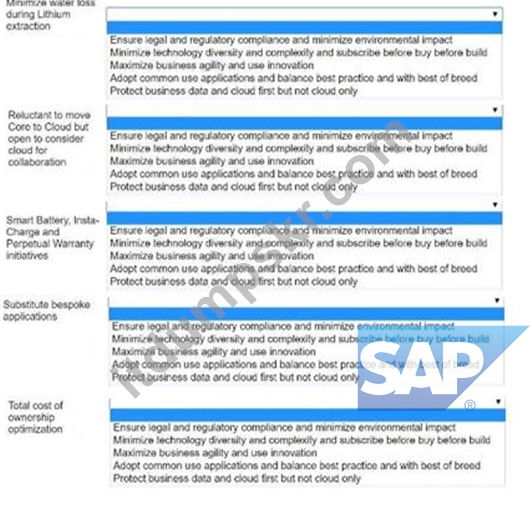
정답:
설명: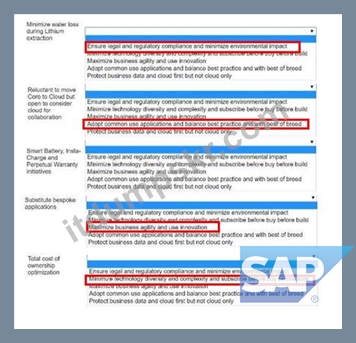
질문 # 36
Green Elk & Company is the world's leading manufacturer of agricultural and forestry machinery. The former company slogan "Elk always runs has recently been changed to "Elk feeds the world". One of Green Elk's strategic goals is to increase its revenue in the emerging markets of China, India, and other parts of Asia by 80% within three years. This requires a new business model that caters to significantly smaller farms with limited budgets. The CIO asks you, the Chief Enterprise Architect, to present an Architecture Roadmap that addresses the business challenge. According to the SAP Enterprise Architecture Framework, what is the best answer?
정답:B
설명:
Explanation
The SAP Enterprise Architecture Framework (EAF) defines an Architecture Roadmap as a "high-level plan that describes the sequence of activities and deliverables required to achieve the target architecture." The roadmap should be based on the artifacts of the previous phases of the EAF, such as the Business Strategy Map, the Solution Concept, and the Baseline Business and Solution Architecture.
The first step in creating an Architecture Roadmap is to define the initiatives that will be needed to achieve the target architecture. These initiatives should be aligned with the business outcomes that the organization is trying to achieve.
The next step is to detail the business capabilities and solutions that will be needed to support the initiatives.
This will help to ensure that the roadmap is realistic and achievable.
Finally, the roadmap should be created in two versions: an outcome-based roadmap and an application-specific roadmap. The outcome-based roadmap will show how the initiatives will achieve the business outcomes. The application-specific roadmap will show how the solutions will be implemented.
By following these steps, you can create an Architecture Roadmap that will help you to achieve your organization's strategic goals.
Here are some of the benefits of creating an Architecture Roadmap:
It can help you to visualize the sequence of activities and deliverables required to achieve your goals.
It can help you to identify dependencies between activities and deliverables.
It can help you to track progress and to make adjustments as needed.
It can help you to communicate your plans to stakeholders.
Therefore, an Architecture Roadmap can be a valuable tool for managing complex transformations.
According to the SAP Enterprise Architecture Framework, which is a methodology and toolset by the German multinational software company SAP that helps enterprise architects define and implement an architecture strategy for their organizations, the steps involved in creating an Architecture Roadmap are:
Reuse the artifacts of previous phases as input for creating roadmaps. The previous phases of the architecture development cycle are: architecture vision, business architecture, information systems architecture, and technology architecture. The artifacts of these phases provide the information and guidance for defining the scope, objectives, stakeholders, requirements, constraints, and solutions of the architecture project. Some of the artifacts that can be reused for creating roadmaps are: stakeholder map, business strategy map, solution strategy, solution context diagram, solution component diagram, solution application use-case diagram, solution value flow diagram, etc.
Start with a roadmap construction table, by defining initiatives and business outcomes, and detailing the business capabilities and solutions. A roadmap construction table is a tool that helps to structure and organize the information and elements that are needed to create a roadmap. It consists of four columns:
initiatives, business outcomes, business capabilities, and solutions. Initiatives are the strategic actions or projects that are planned to achieve the business goals and drivers. Business outcomes are the measurable results or benefits that are expected from implementing the initiatives. Business capabilities are the skills, resources, and competencies that are required or need to mature to support the initiatives and outcomes. Solutions are the products or services that are used or delivered to enable the capabilities and outcomes.
Create two versions of a roadmap (outcome-based and application-specific). A roadmap is a visual representation of the transition architectures that will move the organization from its current state (baseline architecture) to its desired future state (target architecture). A roadmap shows the sequence and timing of the transition architectures, as well as the deliverables, resources, and risks associated with each transition architecture. There are two types of roadmaps that can be created: outcome-based and application-specific. An outcome-based roadmap focuses on the business outcomes that are achieved by implementing the transition architectures. An application-specific roadmap focuses on the solutions or applications that are implemented or changed by the transition architectures.
The other options (A, B, C) are not correct for how to present an Architecture Roadmap that addresses the business challenge because they either skip or misrepresent some of the steps in creating an Architecture Roadmap. For example:
Option A is not correct because it does not include reusing the artifacts of previous phases as input for creating roadmaps, which is an important step to ensure alignment and consistency with the architecture project. It also suggests creating a work breakdown structure instead of a roadmap construction table, which is not a tool in this framework.
Option B is not correct because it does not include creating two versions of a roadmap (outcome-based and application-specific), which is an important step to provide different perspectives and levels of detail for the roadmap. It also suggests focusing on the target architecture instead of the transition architectures, which is not a logical approach since the latter determine how to achieve the former.
Option C is not correct because it does not include starting with a roadmap construction table, which is an important step to structure and organize the information and elements that are needed to create a roadmap. It also suggests focusing on the business strategy map instead of the initiatives and outcomes, which is not a sufficient level of detail for creating a roadmap.
질문 # 37
What kind of applications can you develop with SAP Business Application Studio?
정답:B
설명:
SAP Business Application Studio is a modern development environment designed to support the development of various SAP-centric applications. Among the supported application types are:
SAPUI5 (SAP Fiori) applications (C): SAP Business Application Studio provides extensive tools and templates specifically tailored for developing SAPUI5 applications, which are the backbone of the SAP Fiori user experience. This includes support for frontend development with rich user interfaces, integration with SAP services, and adherence to SAP Fiori design principles.
Options A and B are incorrect because SAP Business Application Studio does not support ABAP development directly within its environment. ABAP development traditionally requires a different set of tools and environments provided by SAP, such as the ABAP Development Tools (ADT) in Eclipse or the ABAP environment on SAP Cloud Platform.
:
SAP Business Application Studio documentation.
SAP Fiori development guidelines provided by SAP.
질문 # 38
Which of the following set of artifacts does SAP provide as part of the SAP Reference Solution Architecture content?
정답:C
설명:
SAP provides several artifacts as part of the SAP Reference Solution Architecture content to guide and streamline solution design and implementation. The artifacts provided are aimed at delivering comprehensive architectural documentation to cover various aspects of the solution architecture. Option B includes the Solution Context Diagram, which provides a high-level view of the system's environment and boundaries. The Solution Component Diagram gives an overview of the components and their interactions within the system. The Solution Application Use-Case Diagram describes how different users will interact with the application. The Solution Value Flow Diagram illustrates the value that flows through the system and between stakeholders.
:
SAP documentation on Solution Architecture best practices.
Resources detailing the SAP Reference Architecture framework.
질문 # 39
As the Chief Enterprise Architect of Wanderlust GmbH, you know that there is very little process documentation available on online marketing processes within Wanderlust. You also know that SAP has a rich End-to-End (E2E) Business Processes content repository. To take advantage of that, you have engaged an SAP Enterprise Architect. The SAP Enterprise Architect is using SAP's Business Process Model (BPM) and the Business Capability Model (BCM) while mapping processes to capabilities, how are the two models connected? Note: There are 2 correct answers to this question.
정답:B,D
설명:
The connection between SAP's Business Process Model (BPM) and the Business Capability Model (BCM) lies in how the end-to-end business processes are enabled by the business domains and capabilities outlined in the BCM. Each business activity in the BPM is supported by one or more business capabilities from the BCM. This linkage ensures that the company's capabilities are directly tied to the business activities and processes, providing a clear line of sight from high-level business strategy down to operational execution.
Reference = This connection is standard in enterprise architecture where processes are designed to be supported by capabilities, ensuring that capabilities provide the necessary functions to execute the processes effectively.
질문 # 40
......
거침없이 발전해나가는 IT업계에서 자신만의 자리를 동요하지 않고 단단히 지킬려면SAP인증 P_SAPEA_2023시험은 무조건 패스해야 합니다. 하지만SAP인증 P_SAPEA_2023시험패스는 하늘에 별따기 만큼 어렵습니다. 시험이 영어로 출제되어 공부자료 마련도 좀 힘든편입니다. 여러분들의 고민을 덜어드리기 위해ITDumpsKR에서는SAP인증 P_SAPEA_2023시험의 영어버전 실제문제를 연구하여 실제시험에 대비한 영어버전SAP인증 P_SAPEA_2023덤프를 출시하였습니다.전문적인 시험대비자료이기에 다른 공부자료는 필요없이ITDumpsKR에서 제공해드리는SAP인증 P_SAPEA_2023영어버전덤프만 공부하시면 자격증을 딸수 있습니다.
P_SAPEA_2023덤프공부자료: https://www.itdumpskr.com/P_SAPEA_2023-exam.html